
Canterbury Kit Designer
A 3D kit designer that let rugby players design bespoke kit, share it with their club, and get the whole team bought in. Grew teamwear orders by 19% in its first year.
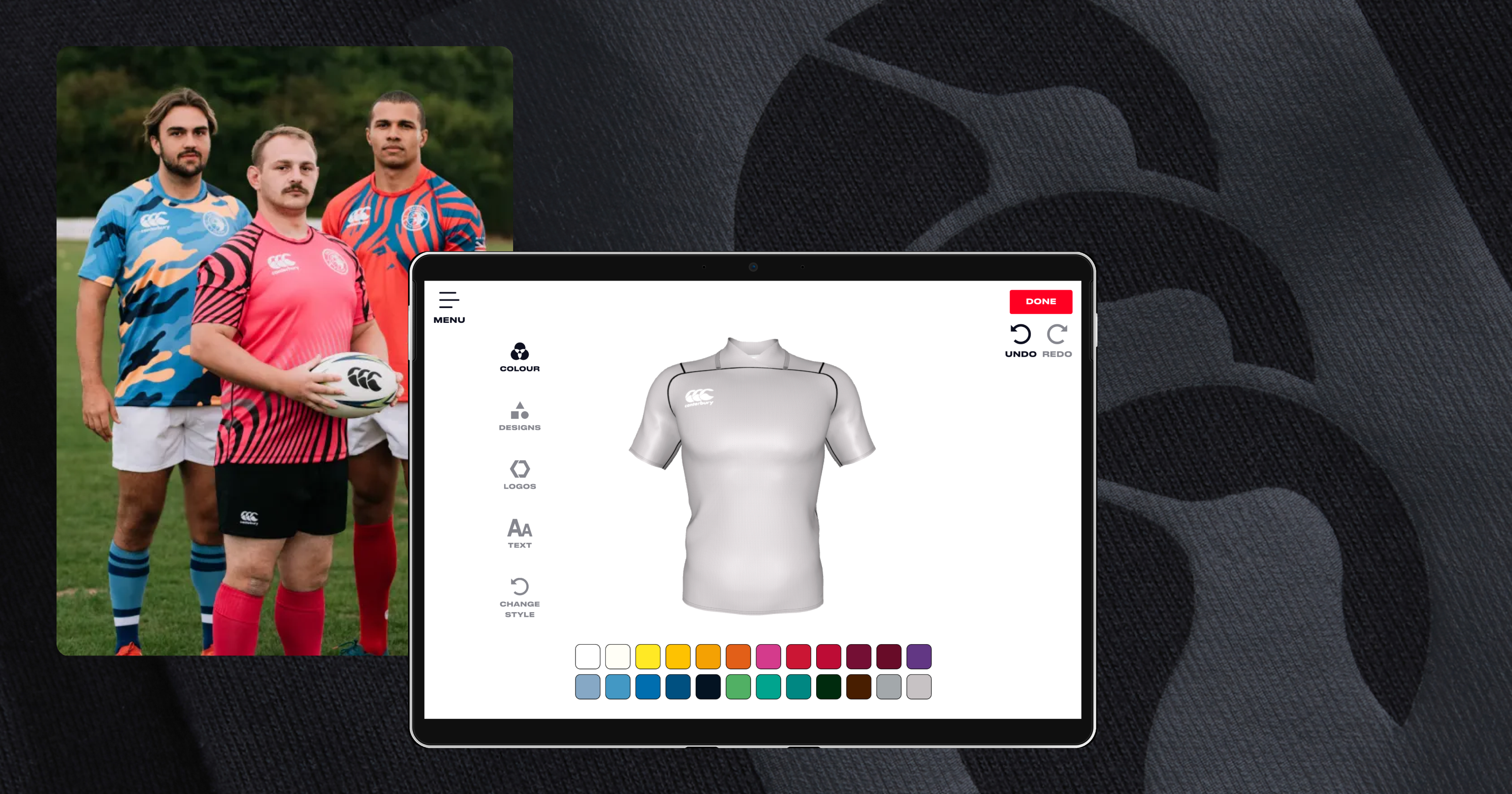
Images above: the Canterbury Kit Designer’s colour screen, where players pick colours for each part of their jersey on a live 3D model. Also showing three players in bespoke Canterbury club kits, the kind of design clubs could create and order through the tool. I designed the kit designer’s UX and UI in Figma.
Overview
Canterbury had a service that created bespoke kit for rugby clubs, but hardly anyone used it. The few clubs that found the service phoned or emailed a brief, a Canterbury graphic designer drew up some options, and it went back and forth until a kit was agreed.
Despite the huge demand and large revenue potential, the service was slow, corporate, and it wasn't making much money.
My brief was to turn that potential into orders, and to improve the process both for the users, and also for the internal teams.
Through user research with rapid prototypes, I found that a live 3D kit model that allowed users to play around with their own designs was the best way of getting them excited and invested in creating a club kit with Canterbury.
As always, there were several constraints to work around. The first one being that the scope was agreed with a development agency before any research or designs were undertaken. Secondly, whatever looked good on screen had to also look great when printed and stitched onto a real product.
My Role
Lead Product Designer, in-house at Pentland Brands (sole designer).
- Owned the UX, UI and information architecture from the start to post-launch optimisation.
- Upskilled the wider team in design thinking, both the process and the importance of it.
- Worked with the external agency's developers on what could be built, the physical product development team on what could be made, and the product manager on what would be profitable.
Brand
Canterbury, part of Pentland Brands (also home to Speedo, Berghaus, Endura and others).
Core Team
Lead Product DesignerSole designer, owning the whole experience: UX, UI, information architecture, product branding, user research, content design, testing and launch
Timeline
Lead Product DesignerSole designer, owning the whole experience: UX, UI, information architecture, product branding, user research, content design, testing and launch
Methods
Lead Product DesignerSole designer, owning the whole experience: UX, UI, information architecture, product branding, user research, content design, testing and launch
Tools
Lead Product DesignerSole designer, owning the whole experience: UX, UI, information architecture, product branding, user research, content design, testing and launch
Impacts
19% increase
in teamwear orders in the first year after launch
Has been used for over
14%
more likely to order if they had shared a kit design they’d made with their teammates.
The Canterbury kit designer was so successful that Pentland then rolled it out to Speedo for swim clubs, scaling up from the MVP.
How it came together
Design for the whole club, not just the kit organiser
Early research told me that there was usually one (un)lucky individual who’d landed the job of organising the team kit. They were often a player on the team, who had volunteered (or had been “volunt-told”) to organise the team kit. Frequently they had no expertise in design or apparel, were very time-poor, and were nervous about creating something the rest of the team would like.
It also became clear that kit design is a team decision. As soon as the kit organiser had a few options they liked, they sent it to the club WhatsApp, and everyone had an opinion.
We saw early on that the designs that got shared with others were the ones that turned into real orders. So I prioritised the sharing journey, designing it as carefully as the kit designer tool itself. I made it easy to share on WhatsApp and social media, and created an auto-generated Canterbury-branded PDF that showed all the kit options side by side, that could be sent round the club by email.
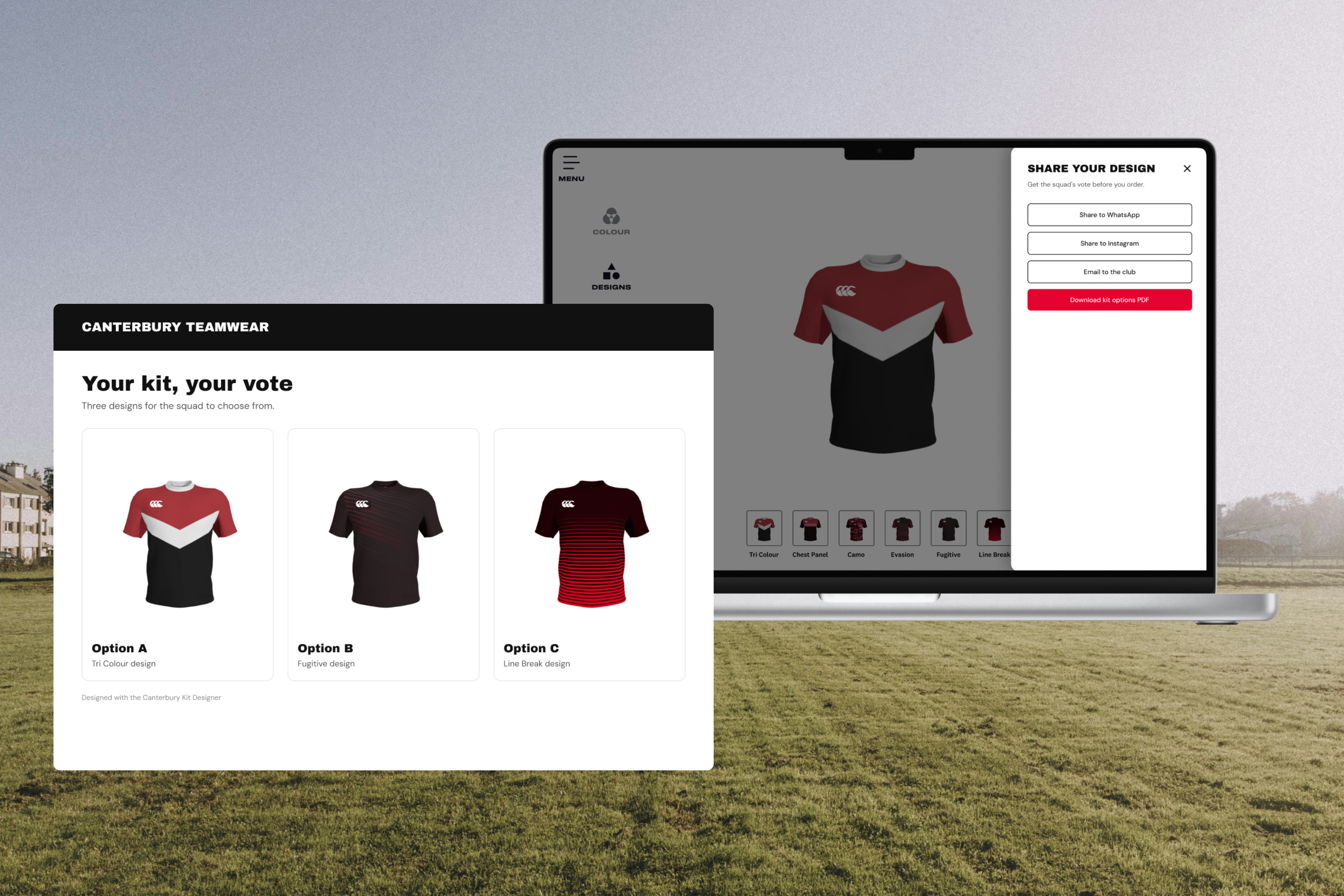
Images above: the sharing journey. From the kit designer, players could send their design straight to WhatsApp, Instagram or email, or download a Canterbury-branded PDF with up to three kit options side by side, ready for the squad to vote on before anyone ordered. Created in Figma.
Balancing the user goals with the business’ profit margin
As soon as we started sharing prototypes, the excitement amongst rugby teams grew fast, but so did the scope.
Things got complicated quickly:
- Clubs wanted to upload their own logos, but inevitably, half of them had lost the SVG.
- They wanted super-specific colours that always turned out to be ones that couldn’t be printed on real products.
- Teams wanted the full kit and caboodle, not just the basics… towels, hoodies, water bottles etc. All of which needed bespoke designs.
I had to consider that every extra requirement ate into the profit margin. So I sat down with rugby players and found the smallest version that still got them excited: jerseys and shorts, with an extra service to recreate their logo in high-res if needed. We dropped the exact colour matching and extra product lines from the MVP to protect the margin.
Give clubs creative freedom, within limits
It turns out that a kit design can look brilliant on screen but not on a real product. For example one of our test prototypes had a seam straight through the team logo. Canterbury also needed every kit, however wild, to still look like Canterbury.
So I worked with the product development team and their graphic designers to turn production and brand rules into guardrails inside the tool. These were a curated set of patterns, colours that could actually be printed, and fixed logo and text positions that avoided seams. I wanted to make sure that clubs still got real creative choice, but also that they didn’t fall in love with a kit we couldn’t make.
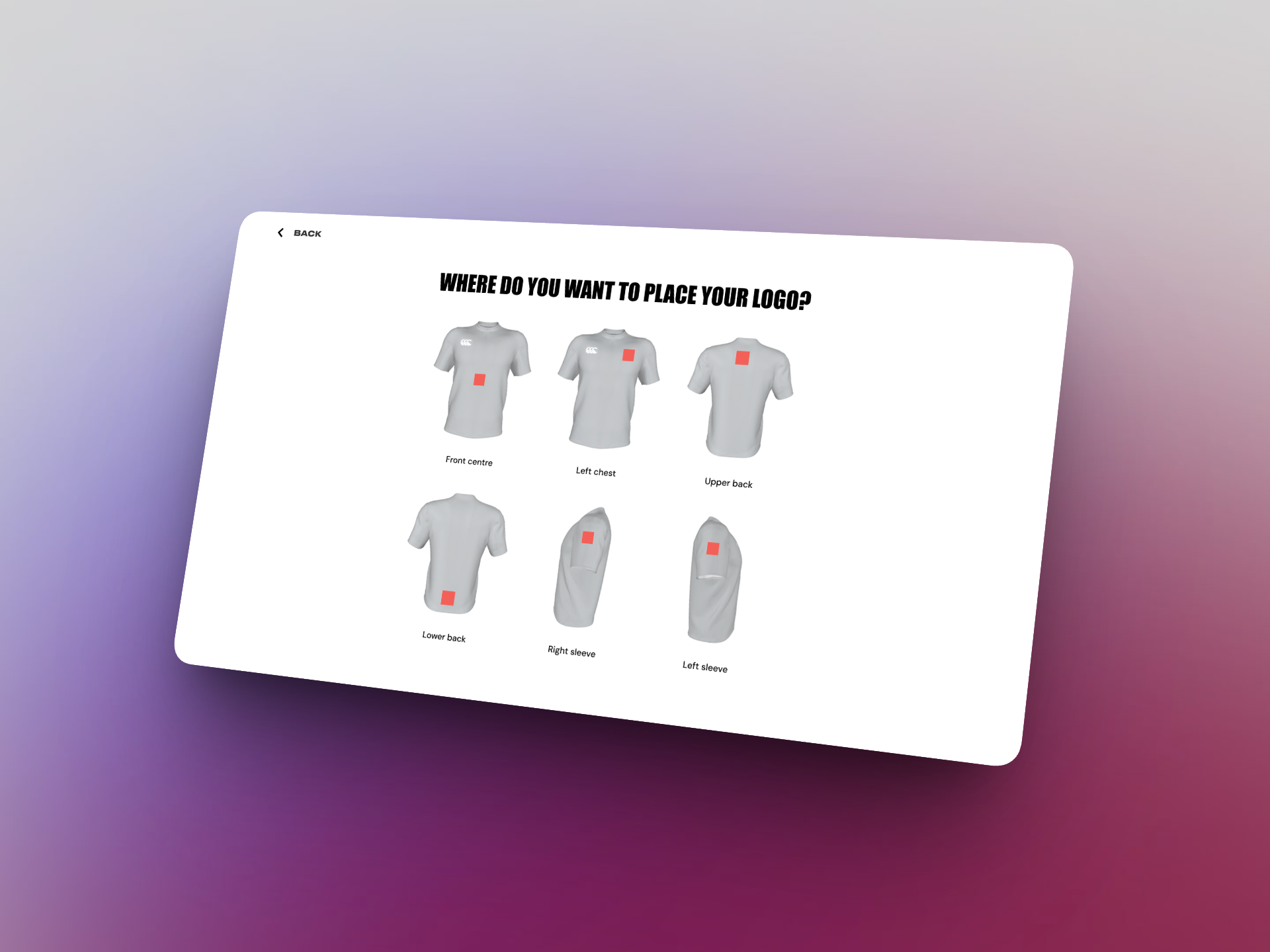
Image Above - One of the guardrails I put in place to make sure users designed kit that could be made into real products. This example shows defined areas where they could add their club logo. Designed in Figma.
Launching it with the fans
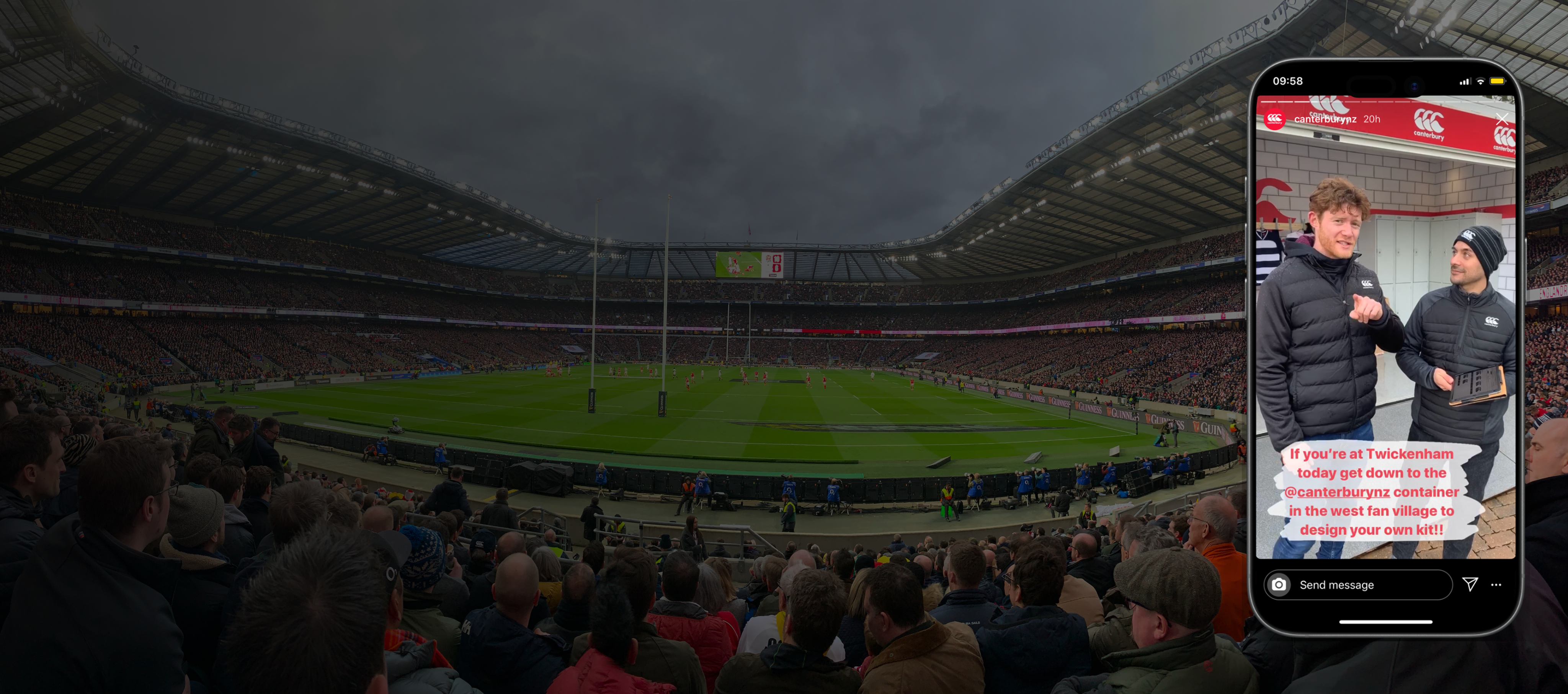
We took the kit designer to the Six Nations, where fans designed kits on the spot. We also ran social competitions where clubs could design their kit and win it.
What happened next: Rolling the kit designer out to Speedo
Once the kit designer had proved itself with Canterbury, Pentland rolled it out to Speedo for swim clubs. Second time round, I could make iterations and build on what we'd learned:
- More of the range. The products we'd held back at launch came in: t-shirts, polos, hoodies, trackies, jackets and shorts.
- A better mobile experience. Most kit organisers wanted to create the designs on their phones, so I redesigned the mobile flow.
- A greater range of creative options for clubs to design with, such as being able to place a name or initials in a variety of locations on the garment.
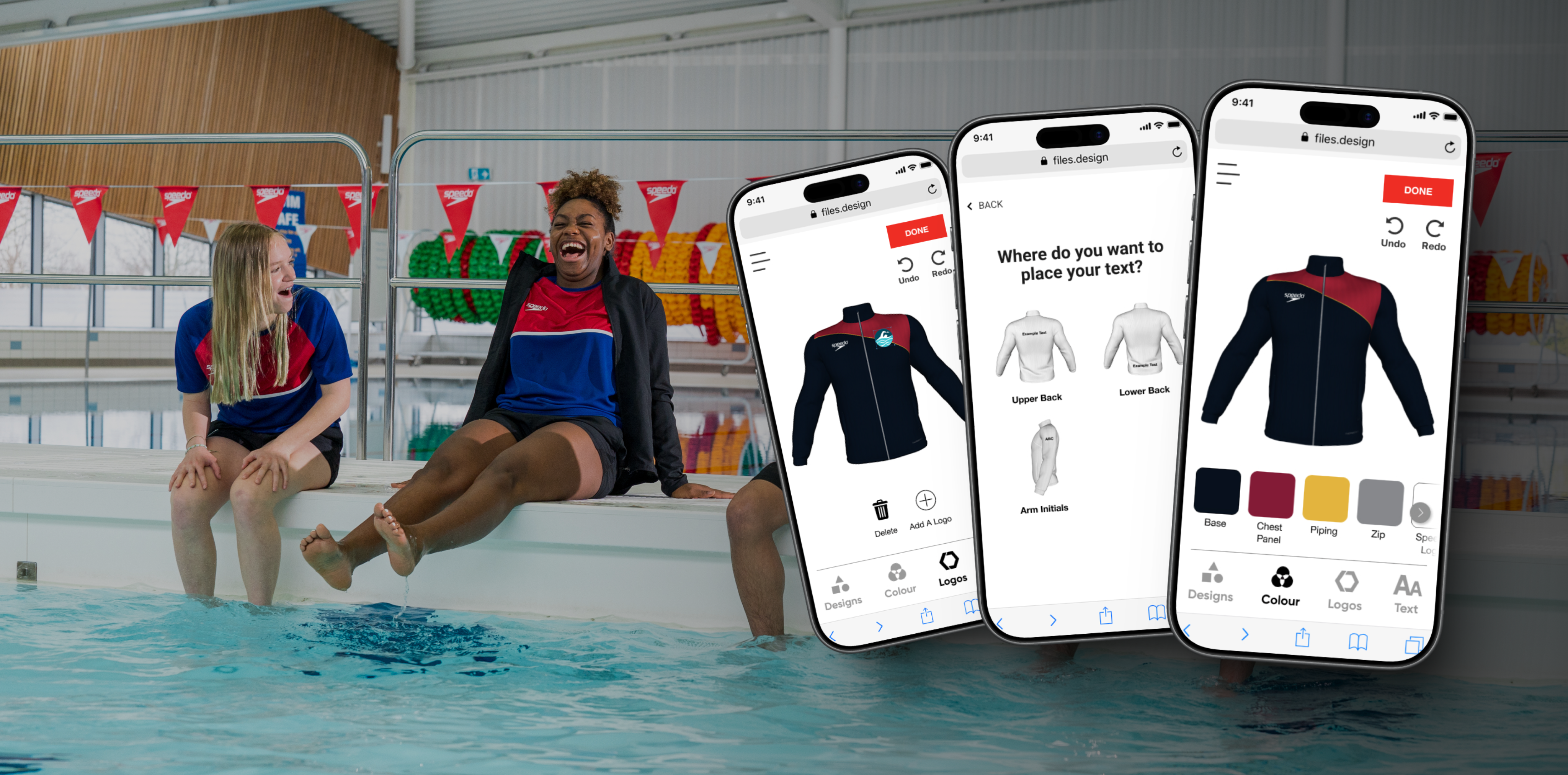
Image above - Version 2 of the Kit Designer, launching for both Speedo and Centerbury. Redesigned for mobile, and incorporating a wider range of products and design options.
because most kit organisers designed on their phones. Clubs could design across the wider range, from tees to jackets, add their club logo, and place a name, nickname or initials on the upper back, lower back or sleeve. Designed in Figma.
Reflections
No project is perfect sadly (one day maybe), including this one. If I did this project again I would make these changes:
- I would push harder for the user research and initial designs to be complete before signing a contract with the development agency. Being trapped inside a predefined scope, regardless of what the users said, wasn’t ideal.
- I'd work in shorter sprints and ship smaller updates more often to keep things simpler, rather than grouping multiple features into big releases.
- I'd bring the wider business into the key scoping decisions. Deciding in a small group was quicker at the time, but it made answering "but why can't we have hoodies?" a lot harder later.
Next Case Study

Canterbury Kit Designer
A 3D kit designer that let rugby players design bespoke kit, share it with their club, and get the whole team bought in. Grew teamwear orders by 19% in its first year.
Images above: the Canterbury Kit Designer’s colour screen, where players pick colours for each part of their jersey on a live 3D model. Also showing three players in bespoke Canterbury club kits, the kind of design clubs could create and order through the tool. I designed the kit designer’s UX and UI in Figma.
Overview
Canterbury had a service that created bespoke kit for rugby clubs, but hardly anyone used it. The few clubs that found the service phoned or emailed a brief, a Canterbury graphic designer drew up some options, and it went back and forth until a kit was agreed.
Despite the huge demand and large revenue potential, the service was slow, corporate, and it wasn't making much money.
My brief was to turn that potential into orders, and to improve the process both for the users, and also for the internal teams.
Through user research with rapid prototypes, I found that a live 3D kit model that allowed users to play around with their own designs was the best way of getting them excited and invested in creating a club kit with Canterbury.
As always, there were several constraints to work around. The first one being that the scope was agreed with a development agency before any research or designs were undertaken. Secondly, whatever looked good on screen had to also look great when printed and stitched onto a real product.
My Role
Lead Product Designer, in-house at Pentland Brands (sole designer).
- Owned the UX, UI and information architecture from the start to post-launch optimisation.
- Upskilled the wider team in design thinking, both the process and the importance of it.
- Worked with the external agency's developers on what could be built, the physical product development team on what could be made, and the product manager on what would be profitable.
Brand
Canterbury, part of Pentland Brands (also home to Speedo, Berghaus, Endura and others).
Core Team
Lead Product DesignerSole designer, owning the whole experience: UX, UI, information architecture, product branding, user research, content design, testing and launch
Timeline
Lead Product DesignerSole designer, owning the whole experience: UX, UI, information architecture, product branding, user research, content design, testing and launch
Methods
Lead Product DesignerSole designer, owning the whole experience: UX, UI, information architecture, product branding, user research, content design, testing and launch
Tools
Lead Product DesignerSole designer, owning the whole experience: UX, UI, information architecture, product branding, user research, content design, testing and launch
Impacts
19% increase
in teamwear orders in the first year after launch
Users were
14%
more likely to order if they had shared a kit design they’d made with their teammates.
The Canterbury kit designer was so successful that Pentland then rolled it out to Speedo for swim clubs, scaling up from the MVP.
How it came together
Design for the whole club, not just the kit organiser
Early research told me that there was usually one (un)lucky individual who’d landed the job of organising the team kit. They were often a player on the team, who had volunteered (or had been “volunt-told”) to organise the team kit. Frequently they had no expertise in design or apparel, were very time-poor, and were nervous about creating something the rest of the team would like.
It also became clear that kit design is a team decision. As soon as the kit organiser had a few options they liked, they sent it to the club WhatsApp, and everyone had an opinion.
We saw early on that the designs that got shared with others were the ones that turned into real orders. So I prioritised the sharing journey, designing it as carefully as the kit designer tool itself. I made it easy to share on WhatsApp and social media, and created an auto-generated Canterbury-branded PDF that showed all the kit options side by side, that could be sent round the club by email.
Images above: the sharing journey. From the kit designer, players could send their design straight to WhatsApp, Instagram or email, or download a Canterbury-branded PDF with up to three kit options side by side, ready for the squad to vote on before anyone ordered. Created in Figma.
Balancing the user goals with the business’ profit margin
As soon as we started sharing prototypes, the excitement amongst rugby teams grew fast, but so did the scope.
Things got complicated quickly:
- Clubs wanted to upload their own logos, but inevitably, half of them had lost the SVG.
- They wanted super-specific colours that always turned out to be ones that couldn’t be printed on real products.
- Teams wanted the full kit and caboodle, not just the basics… towels, hoodies, water bottles etc. All of which needed bespoke designs.
I had to consider that every extra requirement ate into the profit margin. So I sat down with rugby players and found the smallest version that still got them excited: jerseys and shorts, with an extra service to recreate their logo in high-res if needed. We dropped the exact colour matching and extra product lines from the MVP to protect the margin.
Give clubs creative freedom, within limits
It turns out that a kit design can look brilliant on screen but not on a real product. For example one of our test prototypes had a seam straight through the team logo. Canterbury also needed every kit, however wild, to still look like Canterbury.
So I worked with the product development team and their graphic designers to turn production and brand rules into guardrails inside the tool. These were a curated set of patterns, colours that could actually be printed, and fixed logo and text positions that avoided seams. I wanted to make sure that clubs still got real creative choice, but also that they didn’t fall in love with a kit we couldn’t make.
Image Above - One of the guardrails I put in place to make sure users designed kit that could be made into real products. This example shows defined areas where they could add their club logo. Designed in Figma.
Launching it with the fans
We took the kit designer to the Six Nations, where fans designed kits on the spot. We also ran social competitions where clubs could design their kit and win it.
What happened next: Rolling the kit designer out to Speedo
Once the kit designer had proved itself with Canterbury, Pentland rolled it out to Speedo for swim clubs. Second time round, I could make iterations and build on what we'd learned:
- More of the range. The products we'd held back at launch came in: t-shirts, polos, hoodies, trackies, jackets and shorts.
- A better mobile experience. Most kit organisers wanted to create the designs on their phones, so I redesigned the mobile flow.
- A greater range of creative options for clubs to design with, such as being able to place a name or initials in a variety of locations on the garment.
Image above - Version 2 of the Kit Designer, launching for both Speedo and Centerbury. Redesigned for mobile, and incorporating a wider range of products and design options.
because most kit organisers designed on their phones. Clubs could design across the wider range, from tees to jackets, add their club logo, and place a name, nickname or initials on the upper back, lower back or sleeve. Designed in Figma.
Reflections
No project is perfect sadly (one day maybe), including this one. If I did this project again I would make these changes:
- I would push harder for the user research and initial designs to be complete before signing a contract with the development agency. Being trapped inside a predefined scope, regardless of what the users said, wasn’t ideal.
- I'd work in shorter sprints and ship smaller updates more often to keep things simpler, rather than grouping multiple features into big releases.
- I'd bring the wider business into the key scoping decisions. Deciding in a small group was quicker at the time, but it made answering "but why can't we have hoodies?" a lot harder later.
Next Case Study

Canterbury Kit Designer
A 3D kit designer that let rugby players design bespoke kit, share it with their club, and get the whole team bought in. Grew teamwear orders by 19% in its first year.
Images above: the Canterbury Kit Designer’s colour screen, where players pick colours for each part of their jersey on a live 3D model. Also showing three players in bespoke Canterbury club kits, the kind of design clubs could create and order through the tool. I designed the kit designer’s UX and UI in Figma.
Overview
Canterbury had a service that created bespoke kit for rugby clubs, but hardly anyone used it. The few clubs that found the service phoned or emailed a brief, a Canterbury graphic designer drew up some options, and it went back and forth until a kit was agreed.
Despite the huge demand and large revenue potential, the service was slow, corporate, and it wasn't making much money.
My brief was to turn that potential into orders, and to improve the process both for the users, and also for the internal teams.
Through user research with rapid prototypes, I found that a live 3D kit model that allowed users to play around with their own designs was the best way of getting them excited and invested in creating a club kit with Canterbury.
As always, there were several constraints to work around. The first one being that the scope was agreed with a development agency before any research or designs were undertaken. Secondly, whatever looked good on screen had to also look great when printed and stitched onto a real product.
My Role
Lead Product Designer, in-house at Pentland Brands (sole designer).
- Owned the UX, UI and information architecture from the start to post-launch optimisation.
- Upskilled the wider team in design thinking, both the process and the importance of it.
- Worked with the external agency's developers on what could be built, the physical product development team on what could be made, and the product manager on what would be profitable.
Brand
Canterbury, part of Pentland Brands (also home to Speedo, Berghaus, Endura and others).
Core Team
Product manager, external development agency, physical product development team.
Timeline
6 months from start to MVP launch.
Methods
User research, rapid prototyping, information architecture, UX/UI design, testing & iteration, post-launch optimisation
Tools
Figma, UserTesting.com
Impacts
19% increase
in teamwear orders in the first year after launch
Users were
14%
more likely to order if they had shared a kit design they’d made with their teammates.
The Canterbury kit designer was so successful that Pentland then rolled it out to Speedo for swim clubs, scaling up from the MVP.
How it came together
Design for the whole club, not just the kit organiser
Early research told me that there was usually one (un)lucky individual who’d landed the job of organising the team kit. They were often a player on the team, who had volunteered (or had been “volunt-told”) to organise the team kit. Frequently they had no expertise in design or apparel, were very time-poor, and were nervous about creating something the rest of the team would like.
It also became clear that kit design is a team decision. As soon as the kit organiser had a few options they liked, they sent it to the club WhatsApp, and everyone had an opinion.
We saw early on that the designs that got shared with others were the ones that turned into real orders. So I prioritised the sharing journey, designing it as carefully as the kit designer tool itself. I made it easy to share on WhatsApp and social media, and created an auto-generated Canterbury-branded PDF that showed all the kit options side by side, that could be sent round the club by email.
Images above: the sharing journey. From the kit designer, players could send their design straight to WhatsApp, Instagram or email, or download a Canterbury-branded PDF with up to three kit options side by side, ready for the squad to vote on before anyone ordered. Created in Figma.
Balancing the user goals with the business’ profit margin
As soon as we started sharing prototypes, the excitement amongst rugby teams grew fast, but so did the scope.
Things got complicated quickly:
- Clubs wanted to upload their own logos, but inevitably, half of them had lost the SVG.
- They wanted super-specific colours that always turned out to be ones that couldn’t be printed on real products.
- Teams wanted the full kit and caboodle, not just the basics… towels, hoodies, water bottles etc. All of which needed bespoke designs.
I had to consider that every extra requirement ate into the profit margin. So I sat down with rugby players and found the smallest version that still got them excited: jerseys and shorts, with an extra service to recreate their logo in high-res if needed. We dropped the exact colour matching and extra product lines from the MVP to protect the margin.
Give clubs creative freedom, within limits
It turns out that a kit design can look brilliant on screen but not on a real product. For example one of our test prototypes had a seam straight through the team logo. Canterbury also needed every kit, however wild, to still look like Canterbury.
So I worked with the product development team and their graphic designers to turn production and brand rules into guardrails inside the tool. These were a curated set of patterns, colours that could actually be printed, and fixed logo and text positions that avoided seams. I wanted to make sure that clubs still got real creative choice, but also that they didn’t fall in love with a kit we couldn’t make.
Image Above - One of the guardrails I put in place to make sure users designed kit that could be made into real products. This example shows defined areas where they could add their club logo. Designed in Figma.
Launching it with the fans
We took the kit designer to the Six Nations, where fans designed kits on the spot. We also ran social competitions where clubs could design their kit and win it.
What happened next: Rolling the kit designer out to Speedo
Once the kit designer had proved itself with Canterbury, Pentland rolled it out to Speedo for swim clubs. Second time round, I could make iterations and build on what we'd learned:
- More of the range. The products we'd held back at launch came in: t-shirts, polos, hoodies, trackies, jackets and shorts.
- A better mobile experience. Most kit organisers wanted to create the designs on their phones, so I redesigned the mobile flow.
- A greater range of creative options for clubs to design with, such as being able to place a name or initials in a variety of locations on the garment.
Image above - Version 2 of the Kit Designer, launching for both Speedo and Centerbury. Redesigned for mobile, and incorporating a wider range of products and design options. Designed in Figma.
Reflections
No project is perfect sadly (one day maybe), including this one. If I did this project again I would make these changes:
- I would push harder for the user research and initial designs to be complete before signing a contract with the development agency. Being trapped inside a predefined scope, regardless of what the users said, wasn’t ideal.
- I'd work in shorter sprints and ship smaller updates more often to keep things simpler, rather than grouping multiple features into big releases.
- I'd bring the wider business into the key scoping decisions. Deciding in a small group was quicker at the time, but it made answering "but why can't we have hoodies?" a lot harder later.
Next Case Study