
A Global B2B Redesign
120% increase in digital service adoption:
Turning complexity into a unified platform.
the context
Pentland Brands is a fashion & lifestyle portfolio business, owner of global brands such as Speedo, Berghaus, and Canterbury. They supply goods to B2B customers all across the globe, however the service was fragmented & inefficient, with individual market teams using their own portals, spreadsheets, and phone-order workarounds.
In this context, I led the first structured user research Pentland had ever done with their B2B customers, and then led the team to redesign the end-to-end service (as both lead designer, and design team manager).
the challenge
Pentland’s entire partner network (vendors, suppliers, retailers etc.) had no working digital solution that enabled them to work efficiently with Pentland.
Everything relied on Account Managers & Customer Service Reps, with many tasks being manual, done through email & phone calls.
There was very little data or user research to help guide the design of the service, and design-thinking wasn’t at the table at all. And there was no scalability due to these huge inefficiencies.

my role
Senior Digital Experience Manager at Pentland Brands:
I led a technical design team of 5, with ultimate sign-off for all design-related elements.
I was also Lead Designer for the project covering:
User research
Internal research & workshops
Service design
UX Design
Stakeholder management
Running design sprints
Business case development
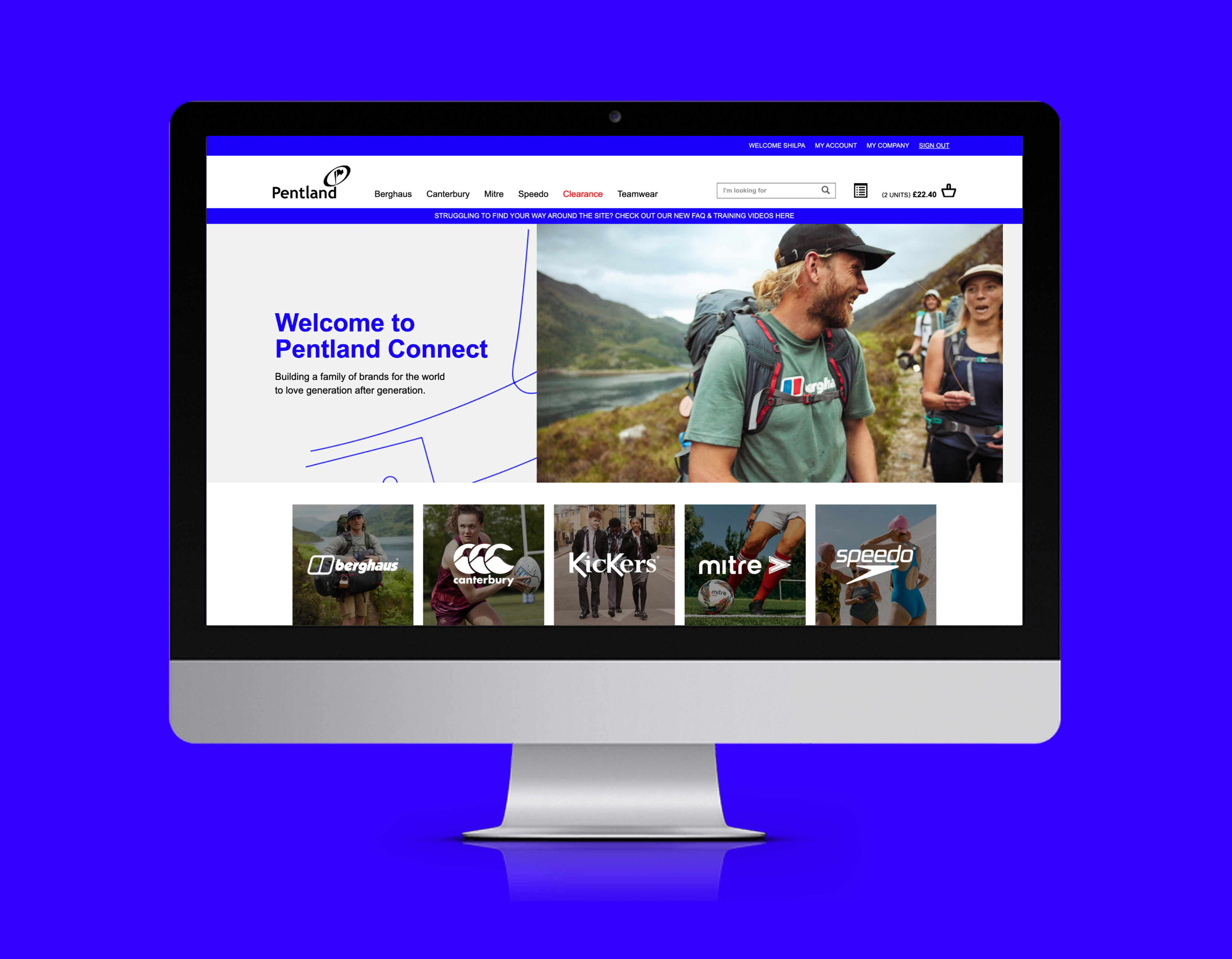
A mockup of the homepage of Pentland Connect on launch, the self-serve Customer portal.
Process
My
Flow

💬
🗺️
📈
🖌️
🎨
🧪
- Testing & rollout
Myself & the wider team ran what felt like every test on the planet! Automated technical testing, A/B tests, hypercare periods etc. I was responsible for managing the pilot tests and graduated rollout across the markets, tracking adoption & operational impact — which is how we got to +120% adoption after 2 years.
- Mapping & blueprinting
I mapped the real internal service experience highlighting the inefficiencies and broken links, mapped the data flows with BAs, & untangled permissions & compliance problems with Legal.
My output: Business workflow maps & "As Is" service blueprints
5. Designing the detail
I drove focused design sprints with UXUI designers and the software development team, using rapid prototyping and iterative user testing to create a new B2B experience that customers & staff would find easy & enjoyable to use.
4. Designing the high-level experience
Onto the design... working with the BAs, I created new “To Be” service blueprints and user flows (for both external customers and internal teams) mapping out how the new service would work - rapid testing and iterating along the way.
3. Business case to C-Suite for approval
I owned the digital workstreams of the business case, presenting evidence, risks, and phased investment options to senior leadership. The result was C-suite alignment and a mandate to lead the programme across EMEA.
1. Multi-market discovery
Spoke to customers and teams across EMEA, shadowed sales reps, and pulled apart wildly different workflows to understand why everyone was solving the same problems differently.
the hurdles 🚧... and how i overcame them
⏱️ Legacy platforms & a huge time crunch

The ERP system we were using was creaking at the seams causing problems for staff and Customers alike. And the contract was ending, with no option (or desire!) to be renewed. Time was limited.
I worked with the C-Suite sponsors to create a very clear project scope, and a process through which any proposed change to priorities could be decided on quickly, with minimum beaurocracy.
Conflicting stakeholders 🤬
7 different brand teams, all with their own Sales, Service, Logistics, and Legal processes. All who naturally thought their process was the best...
I set up a cross-functional design council with a clear RACI. Using the user stories above I fought for alignment on the common user stories that would benefit all brands & markets. Then we went after those together.
Operational readiness & change management ⚠️️
There’s never a good time for a huge change like this. Everyone was worried about something, and usually with good reason. I had to manage this replatform with minimal disruption to sales
I co-designed with frontline teams, built walkthroughs into the product, and set OKRs (adoption, self-serve, ticket deflection) so operations could see the impact and adjust.
🔐 GDPR, privacy & role-based access ️
The ERP system we were using was creaking at the seams causing problems for staff and Customers alike. And the contract was ending, with no option (or desire!) to be renewed. Time was limited.
I worked with the C-Suite sponsors to create a very clear project scope, and a process through which any proposed change to priorities could be decided on quickly, with minimum beaurocracy.
Legacy platforms & zero-disruption migration
The challenge was a patchwork of market-specific builds and workarounds that made consistency and maintenance hard.
I designed an 80/20 model—80% global, 20% customisable—with light localisation rules and a simple governance checklist so markets could tailor within bounds while keeping a sustainable global process.
🇪🇺 Cross-cultural collaboration & ways of working
There’s never a good time for a huge change like this. Everyone was worried about something, and usually with good reason. I had to manage this replatform with minimal disruption to sales
I co-designed with frontline teams, built walkthroughs into the product, and set OKRs (adoption, self-serve, ticket deflection) so operations could see the impact and adjust.
the results
- The launch of the Customer Portal transformed the way this arm of the organisation worked.
- From slow, manual, & cumbersome, to simple, intuitive, & fast.
- We saw an uptake of the service by +120% over the following 2 years.

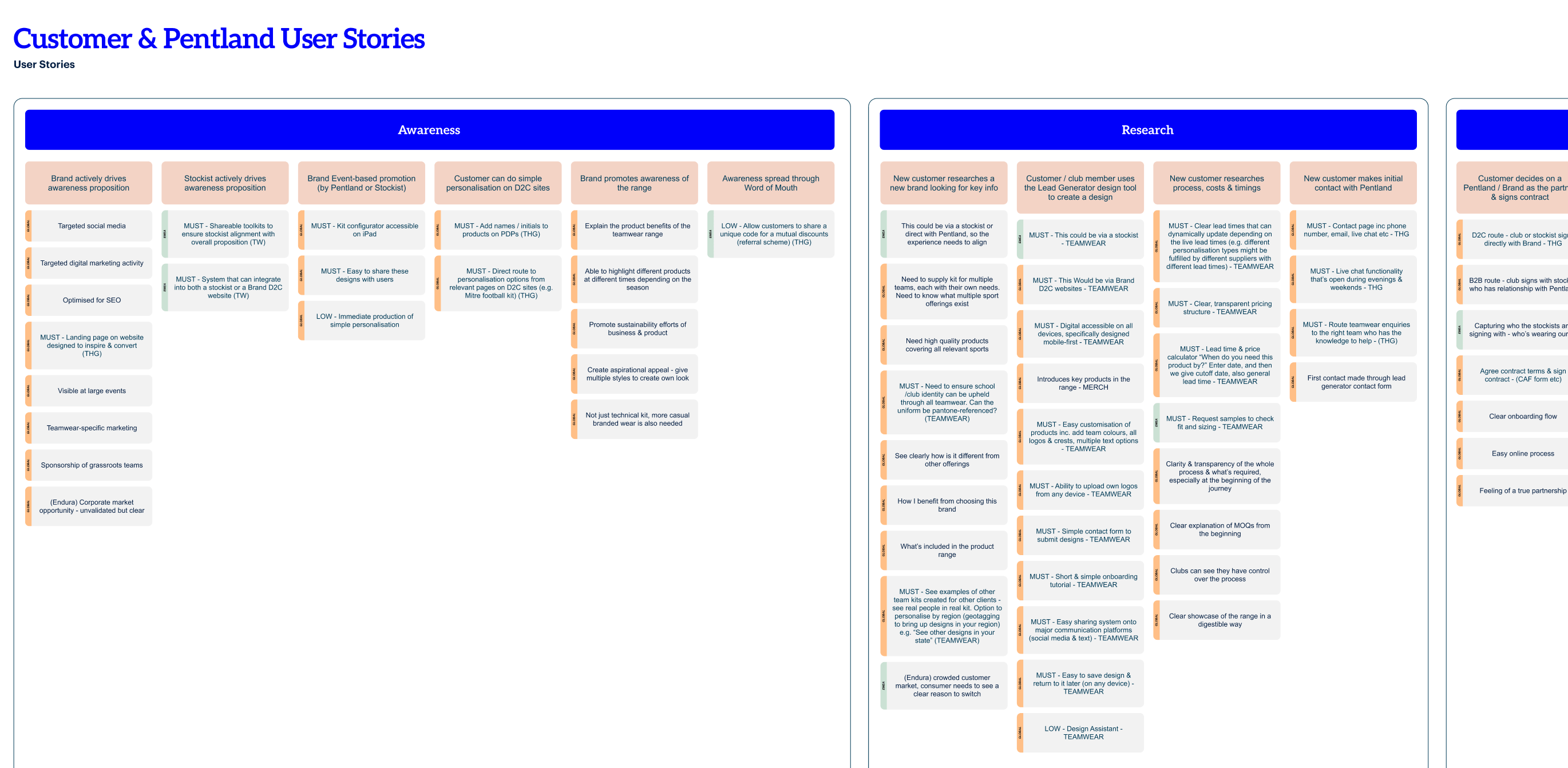
A screengrab of a comprehensive set of user stories that I created on the back of 2 rounds of user research with both internal and external stakeholders. These user stories covered the whole customer user journey, from first awareness to long-term customer retention. It also broke out whether the user story was global or market-specific.
These user stories acted as the first source of truth for the business to define & understand the scale of the problem. I used these user stories to work with the CIO of Pentland Brands (and his team) to prioritise which were they key problems to solve in this project (using a matrix of business profitability and impact on the user). This both formed the project scope, and also the subsequent roadmap for later development.

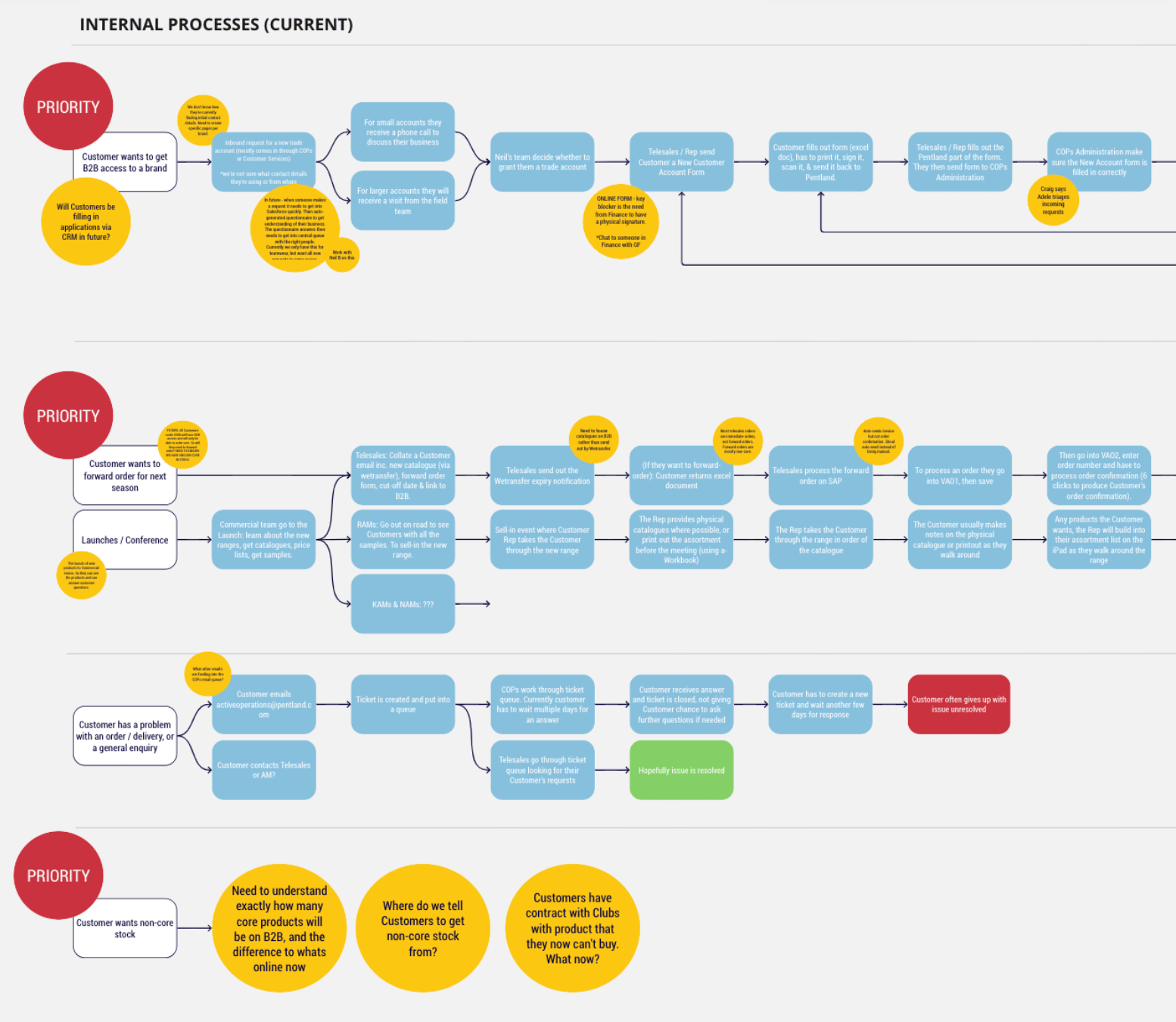
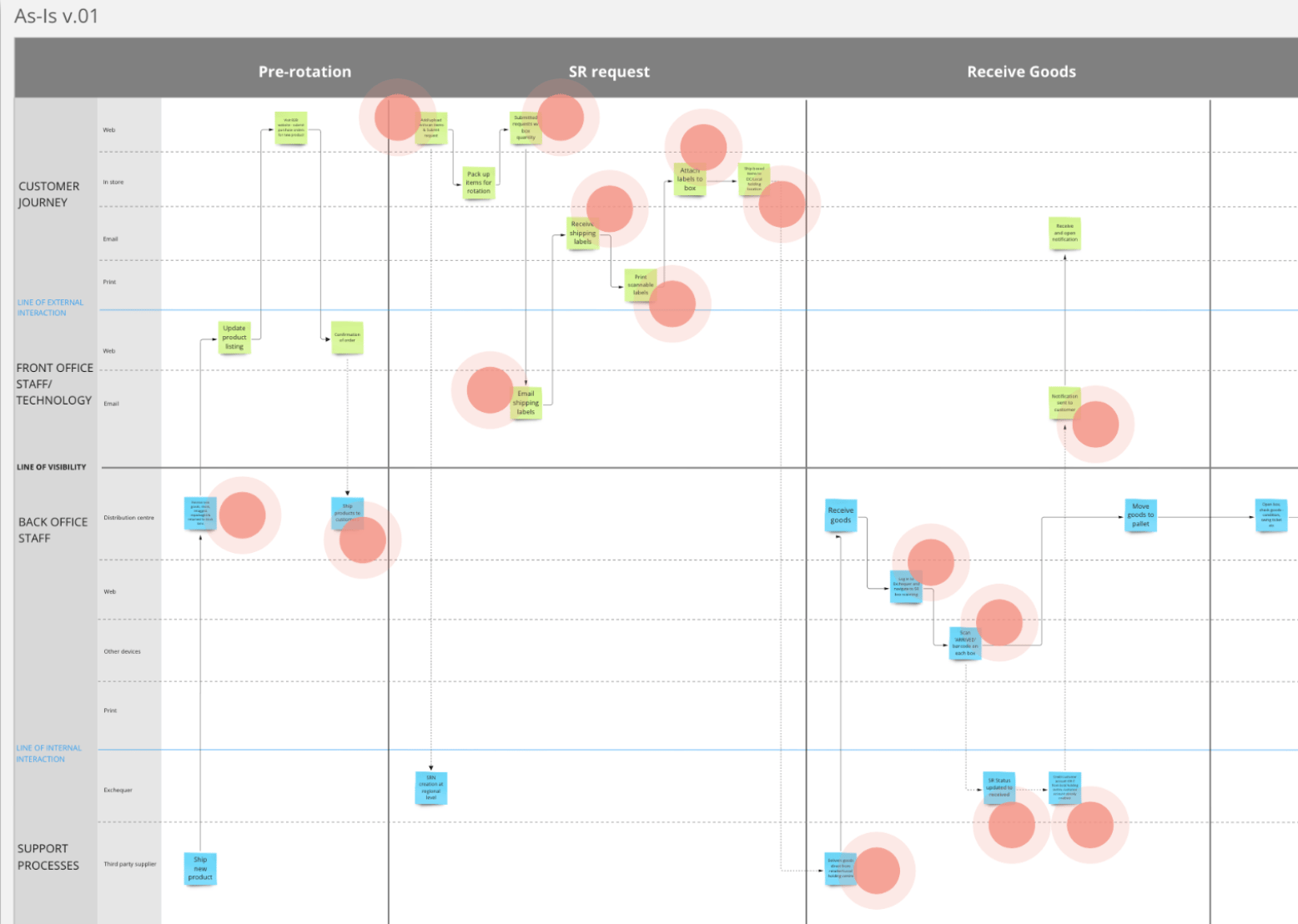
Examples from my business workflow user flows that I built through my research with various internal teams. I then turned these into the first “As Is” service blueprints to map the external customer journey with the internal processes.
I used these service blueprints (there were several blueprints, each covering a key business process) to demonstrate the pain points and inefficiencies to senior stakeholders and budget holders, to highlight where we should focus our efforts and where the largest business gains could be found.

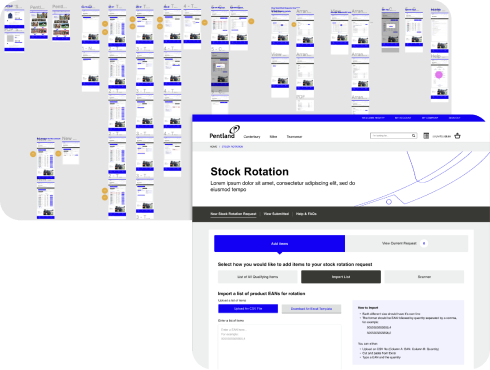
A view of the working Figma design file covering all the possible website change states, error messages, variations etc. The working prototype is available to view through the button above.
These screens, along with the prototype were used predominantly by the Engineers and BAs as they built the portal. The detail shown through the many screen variations covered all the user stories that the portal had to cater for as a Customer moved through their online journey.
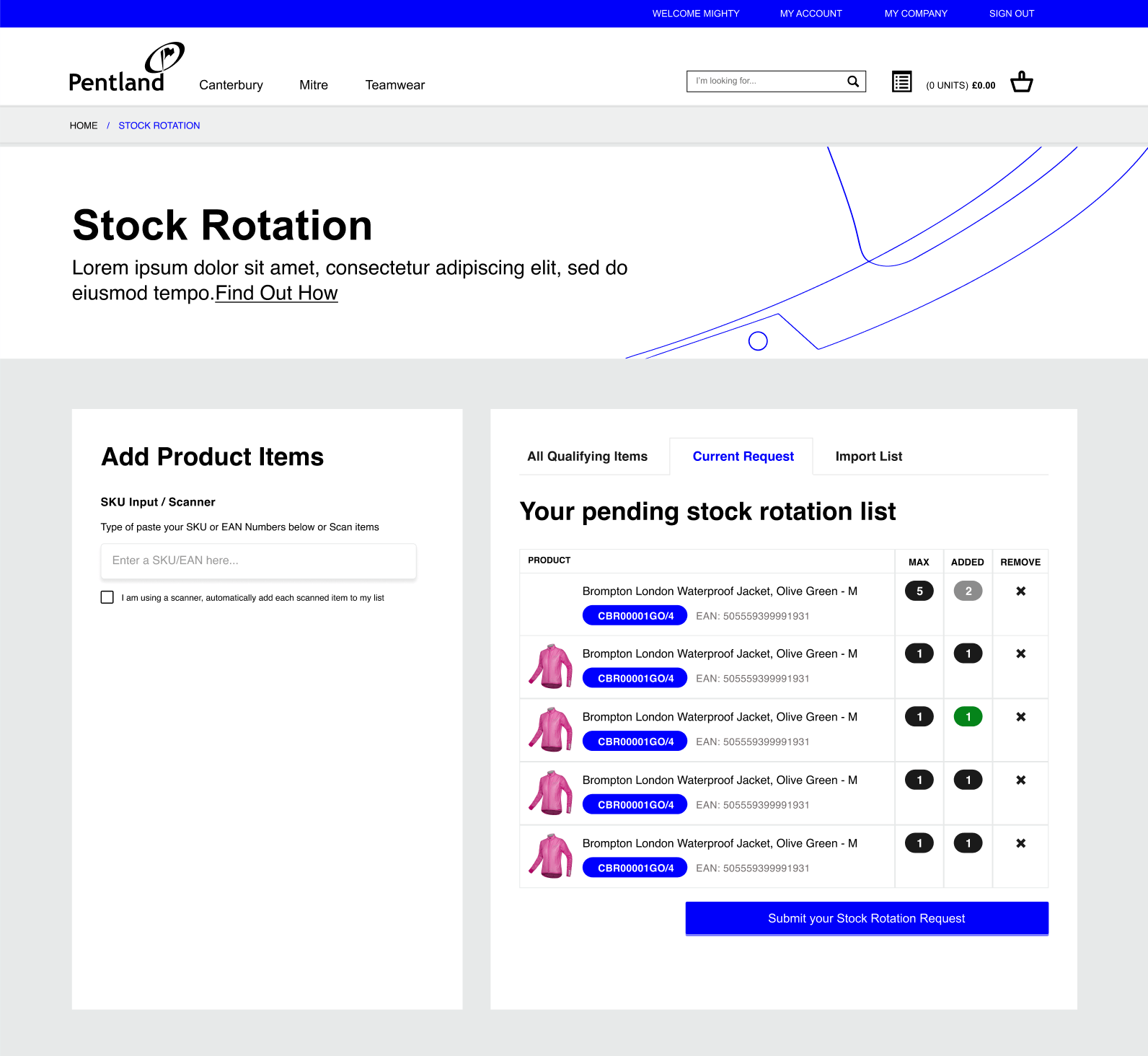
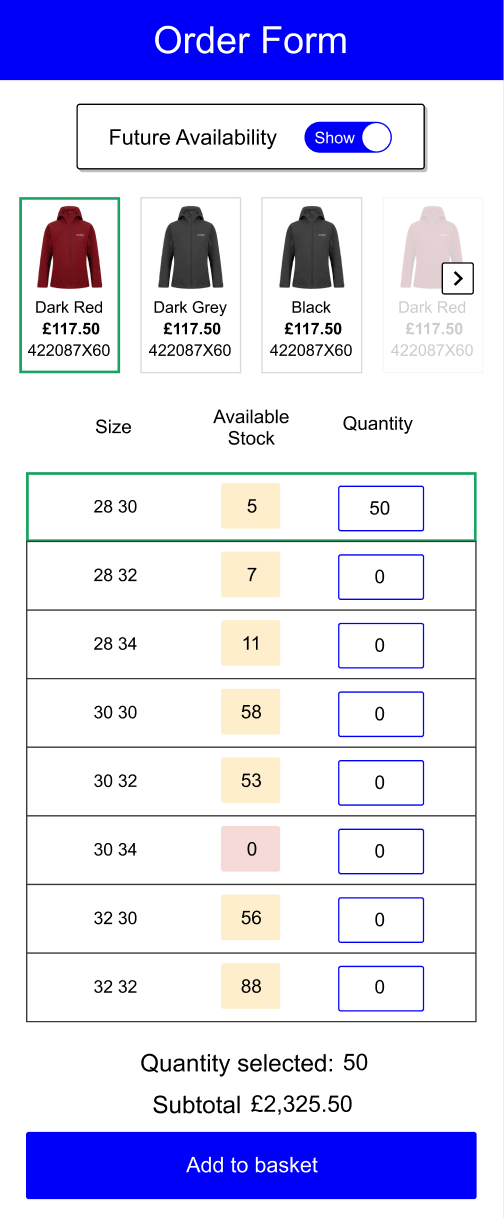
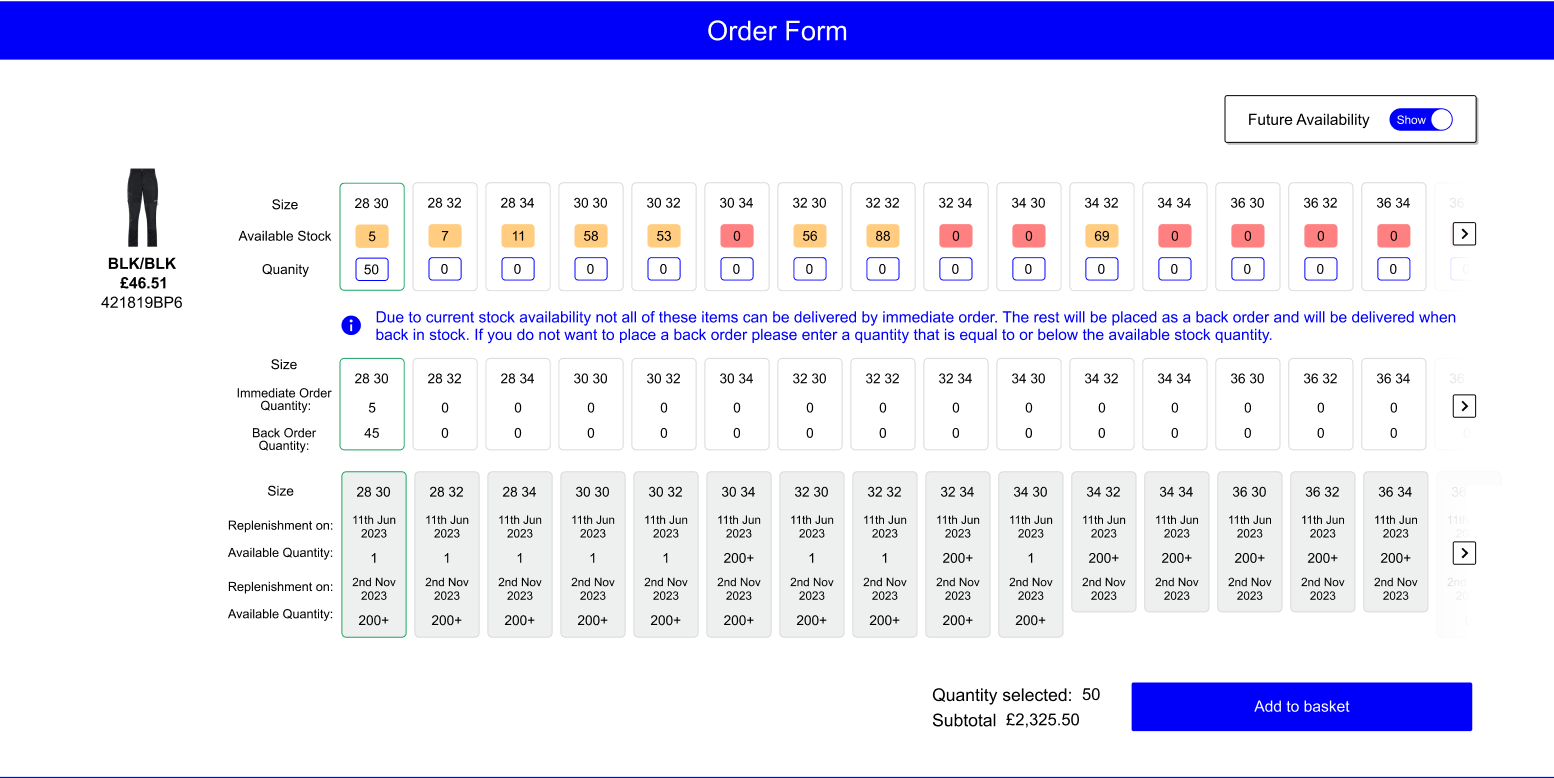
A selection of screengrabs from my designs that were handed over to the Engineers using Figma Dev Mode. These were created within the existing Pentland design system, and I provided
Next Case Study

A Global B2B Redesign
120% increase in digital service adoption:
Turning complexity into a unified platform.
the context
Pentland Brands is a fashion & lifestyle portfolio business, owner of global brands such as Speedo, Berghaus, and Canterbury. They supply goods to B2B customers all across the globe, however the service was fragmented & inefficient, with individual market teams using their own portals, spreadsheets, and phone-order workarounds.
In this context, I led the first structured user research Pentland had ever done with their B2B customers, and then led the team to redesign the end-to-end service (as both lead designer, and design team manager).
the challenge
Pentland’s entire partner network (vendors, suppliers, retailers etc.) had no working digital solution that enabled them to work efficiently with Pentland.
Everything relied on Account Managers & Customer Service Reps, with many tasks being manual, done through email & phone calls.
There was very little data or user research to help guide the design of the service, and design-thinking wasn’t at the table at all. And there was no scalability due to these huge inefficiencies.
my role
Senior Digital Experience Manager at Pentland Brands:
I led a technical design team of 5, with ultimate sign-off for all design-related elements.
I was also Lead Designer for the project covering:
User research
Internal research & workshops
Service design
UX Design
Stakeholder management
Running design sprints
Business case development
A mockup of the homepage of Pentland Connect on launch, the self-serve Customer portal.
Process
My
Flow

💬
🗺️
📈
🖌️
🎨
🧪
6. Testing & rollout
Myself & the wider team ran what felt like every test on the planet! Automated technical testing, A/B tests, hypercare periods etc. I was responsible for managing the pilot tests and graduated rollout across the markets, tracking adoption and operational impact — which is how we got to +120% adoption after 2 years.
- Mapping & blueprinting
I mapped the real internal service experience highlighting all the inefficiencies and broken links, mapped the data flows with BAs, & untangled permissions & compliance problems with Legal. My output: Business workflow
maps & "As Is" service blueprints
- Designing the detail
I drove focused design sprints with UXUI designers and the software development team, using rapid prototyping and iterative user testing to create a new B2B experience that customers & staff would find easy & enjoyable to use.
4. Designing the high-level experience
Onto the design... working with the BAs, I created new “To Be” service blueprints and user flows (for both external customers and internal teams) mapping out how the new service would work - rapid testing and iterating along the way.
- Business case to C-Suite for approval
I owned the digital workstreams of the business case, presenting evidence, risks, and phased investment options to senior leadership. The result was C-suite alignment and a mandate to lead the programme across EMEA.
- Multi-market discovery
Spoke to customers and teams across EMEA, shadowed sales reps, and pulled apart wildly different workflows to understand why everyone was solving the same problems differently.
the hurdles 🚧... and how i overcame them
⏱️ Legacy platforms & a huge time crunch

The ERP system we were using was creaking at the seams causing problems for staff and Customers alike. And the contract was ending, with no option (or desire!) to be renewed. Time was limited.
I worked with the C-Suite sponsors to create a very clear project scope, and a process through which any proposed change to priorities could be decided on quickly, with minimum beaurocracy.
Conflicting stakeholders 🤬

7 different brand teams, all with their own Sales, Service, Logistics, and Legal processes. All who naturally thought their process was the best...
I set up a cross-functional design council with a clear RACI. Using the user stories above I fought for alignment on the common user stories that would benefit all brands & markets. Then we went after those together.
Operational readiness & change management ⚠️️
There’s never a good time for a huge change like this. Everyone was worried about something, and usually with good reason. I had to manage this replatform with minimal disruption to sales
I co-designed with frontline teams, built walkthroughs into the product, and set OKRs (adoption, self-serve, ticket deflection) so operations could see the impact and adjust.
🔐 GDPR, privacy & role-based access ️

The ERP system we were using was creaking at the seams causing problems for staff and Customers alike. And the contract was ending, with no option (or desire!) to be renewed. Time was limited.
I worked with the C-Suite sponsors to create a very clear project scope, and a process through which any proposed change to priorities could be decided on quickly, with minimum beaurocracy.
Legacy platforms & zero-disruption migration

The challenge was a patchwork of market-specific builds and workarounds that made consistency and maintenance hard.
I designed an 80/20 model—80% global, 20% customisable—with light localisation rules and a simple governance checklist so markets could tailor within bounds while keeping a sustainable global process.
🇪🇺 Cross-cultural collaboration & ways of working
There’s never a good time for a huge change like this. Everyone was worried about something, and usually with good reason. I had to manage this replatform with minimal disruption to sales
I co-designed with frontline teams, built walkthroughs into the product, and set OKRs (adoption, self-serve, ticket deflection) so operations could see the impact and adjust.
+120%
the results
- The launch of the Customer Portal transformed the way this arm of the organisation worked.
- From slow, manual, & cumbersome, to simple, intuitive, & fast.
- We saw an uptake of the service by +120% over the following 2 years.
A screengrab of a comprehensive set of user stories that I created on the back of 2 rounds of user research with both internal and external stakeholders. These user stories covered the whole customer user journey, from first awareness to long-term customer retention. It also broke out whether the user story was global or market-specific.
These user stories acted as the first source of truth for the business to define & understand the scale of the problem. I used these user stories to work with the CIO of Pentland Brands (and his team) to prioritise which were they key problems to solve in this project (using a matrix of business profitability and impact on the user). This both formed the project scope, and also the subsequent roadmap for later development.
Examples from my business workflow user flows that I built through my research with various internal teams. I then turned these into the first “As Is” service blueprints to map the external customer journey with the internal processes.
I used these service blueprints (there were several blueprints, each covering a key business process) to demonstrate the pain points and inefficiencies to senior stakeholders and budget holders, to highlight where we should focus our efforts and where the largest business gains could be found.
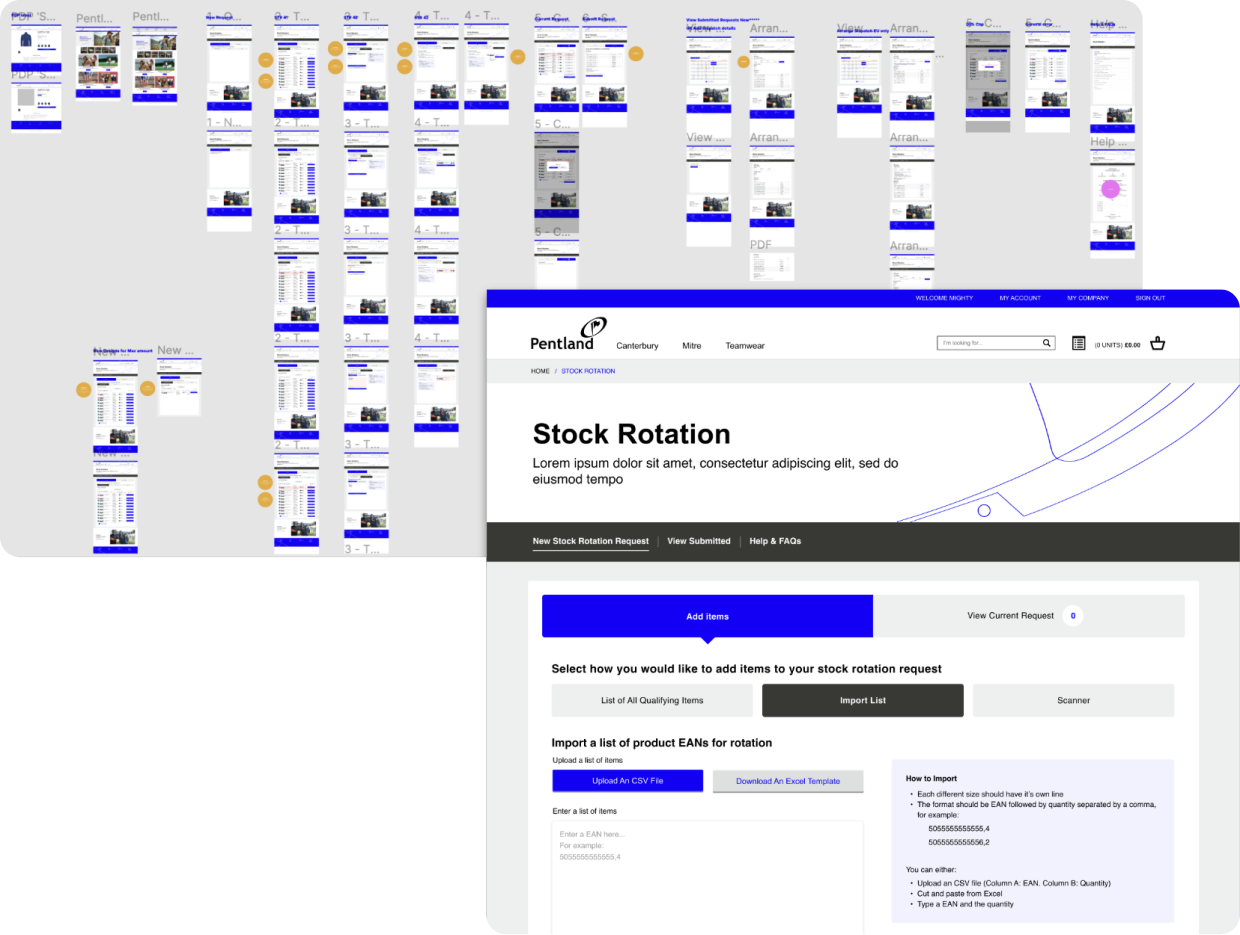
A view of the working Figma design file covering all the possible website change states, error messages, variations etc. The working prototype is available to view through the button above.
These screens, along with the prototype were used predominantly by the Engineers and BAs as they built the portal. The detail shown through the many screen variations covered all the user stories that the portal had to cater for as a Customer moved through their online journey.
A selection of screengrabs from my designs that were handed over to the Engineers using Figma Dev Mode. These were created within the existing Pentland design system, and I provided
Next Case Study

A Global B2B Redesign
120% increase in digital service adoption:
Turning complexity into a unified platform.
the context
Pentland Brands is a fashion & lifestyle portfolio business, owner of global brands such as Speedo, Berghaus, and Canterbury. They supply goods to B2B customers all across the globe, however the service was fragmented & inefficient, with individual market teams using their own portals, spreadsheets, and phone-order workarounds.
In this context, I led the first structured user research Pentland had ever done with their B2B customers, and then led the team to redesign the end-to-end service (as both lead designer, and design team manager).
the challenge
Pentland’s entire partner network (vendors, suppliers, retailers etc.) had no working digital solution that enabled them to work efficiently with Pentland.
Everything relied on Account Managers & Customer Service Reps, with many tasks being manual, done through email & phone calls.
There was very little data or user research to help guide the design of the service, and design-thinking wasn’t at the table at all. Due to these huge inefficiencies it was impossible to scale the service.
my role
Senior Digital Experience Manager at Pentland Brands:
I led a technical design team of 5, with ultimate sign-off for all design-related elements.
I was also Lead Designer for the project covering:
User research
Internal research & workshops
Service design
UX Design
Stakeholder management
Running design sprints
Business case development
A mockup of the homepage of Pentland Connect on launch, the self-serve Customer portal.
Process
My
Flow

💬
🗺️
📈
🖌️
🎨
🧪
Testing & rollout
Myself & the wider team ran what felt like every test on the planet! Automated technical testing, A/B tests, hypercare periods etc. I was responsible for managing the pilot tests and graduated rollout across the markets, tracking adoption and operational impact — which is how we got to +120% adoption after 2 years.
Mapping & blueprinting
I mapped the real internal service experience highlighting all the inefficiencies and broken links, mapped the data flows with BAs, & untangled permissions & compliance problems with Legal.
My output: Business workflow maps & "As Is" service blueprints
Designing the detail
I drove focused design sprints with UXUI designers and the software development team, using rapid prototyping and iterative user testing to create a new B2B experience that customers & staff would find easy & enjoyable to use.
Designing the high-level experience
Onto the design... working with the BAs, I created new “To Be” service blueprints and user flows (for both external customers and internal teams) mapping out how the new service would work - rapid testing and iterating along the way.
Business case to C-Suite for approval
Myself and the Global Product Manager owned the end-to-end business case, and positioned the discovery findings in terms of adoption, efficiency, cost savings & scalability. The output: C-suite signed off our proposal for a multi-market redesign.
Multi-market discovery
I led the external & internal research, speaking to customers & teams across EMEA through user interviews, letting them have a good rant about their roles, tasks, blockers, and frustrations!
My output: a mega-map of user stories & customer journeys.
4.
2.
6.
3.
1.
5.
the hurdles 🚧... and how i overcame them
⏱️ Legacy platforms & a huge time crunch

The ERP system we were using was creaking at the seams causing problems for staff and Customers alike. And the contract was ending, with no option (or desire!) to be renewed. Time was limited.
I worked with the C-Suite sponsors to create a clear project scope, and a process through which any proposed change to priorities could be decided on quickly, with minimum bureaucracy.
🤬 Conflicting stakeholders

7 different brand teams, all with their own Sales, Service, Logistics, and Legal processes. All who naturally thought their process was the best...
I set up a cross-functional design council with a clear RACI. Using the user stories above I fought for alignment on the common user stories that would benefit all brands & markets. Then we went after those together.
⚠ Operational readiness & change management
There’s never a good time for a change like this. Everyone was worried about something, and often with good reason. I had to manage this project with minimal disruption to sales and customer experience.
I co-designed with frontline teams, built walkthroughs into the timeline, and set short-term KPIs so any negative impact was seen & adjusted to quickly.
🔐 GDPR, privacy & role-based access ️
Due to the multi-market nature of the project, the question of data ownership and locale-specific laws became a big hurdle to overcome. The existing experience had fragmented flows that risked breaching GDPR and local rules.
I worked with BAs--- to map the data flows, and with Legal to set the right permissions and data access, in line with local data laws.
🌎 Global consistency vs multi-market localisation
The challenge was a patchwork of market-specific builds and workarounds that made consistency and maintenance hard.
I designed an 80/20 model—80% global, 20% customisable—with light localisation rules and a simple governance checklist so markets could tailor within bounds while keeping a sustainable global process.
🇪🇺 Cross-cultural collaboration & ways of working
The challenge was aligning teams across EMEA with different communication styles, decision norms, and risk tolerance.
I set shared rituals (decision logs, design reviews), used plain-language artefacts, appointed local champions, and ran async-first updates with market-specific demos and testing to respect local context while keeping one direction.
+120%
the results
- The launch of the Customer Portal transformed the way this arm of the organisation worked.
- From slow, manual, & cumbersome, to simple, intuitive, & fast.
- We saw an uptake of the service by +120% over the following 2 years.
A screengrab of a comprehensive set of user stories that I created on the back of 2 rounds of user research with both internal and external stakeholders. These user stories covered the whole customer user journey, from first awareness to long-term customer retention. It also broke out whether the user story was global or market-specific.
These user stories acted as the first source of truth for the business to define & understand the scale of the problem. I used these user stories to work with the CIO of Pentland Brands (and his team) to prioritise which were they key problems to solve in this project (using a matrix of business profitability and impact on the user). This both formed the project scope, and also the subsequent roadmap for later development.
Examples from my business workflow user flows that I built through my research with various internal teams. I then turned these into the first “As Is” service blueprints to map the external customer journey with the internal processes.
I used these service blueprints (there were several blueprints, each covering a key business process) to demonstrate the pain points and inefficiencies to senior stakeholders and budget holders, to highlight where we should focus our efforts and where the largest business gains could be found.
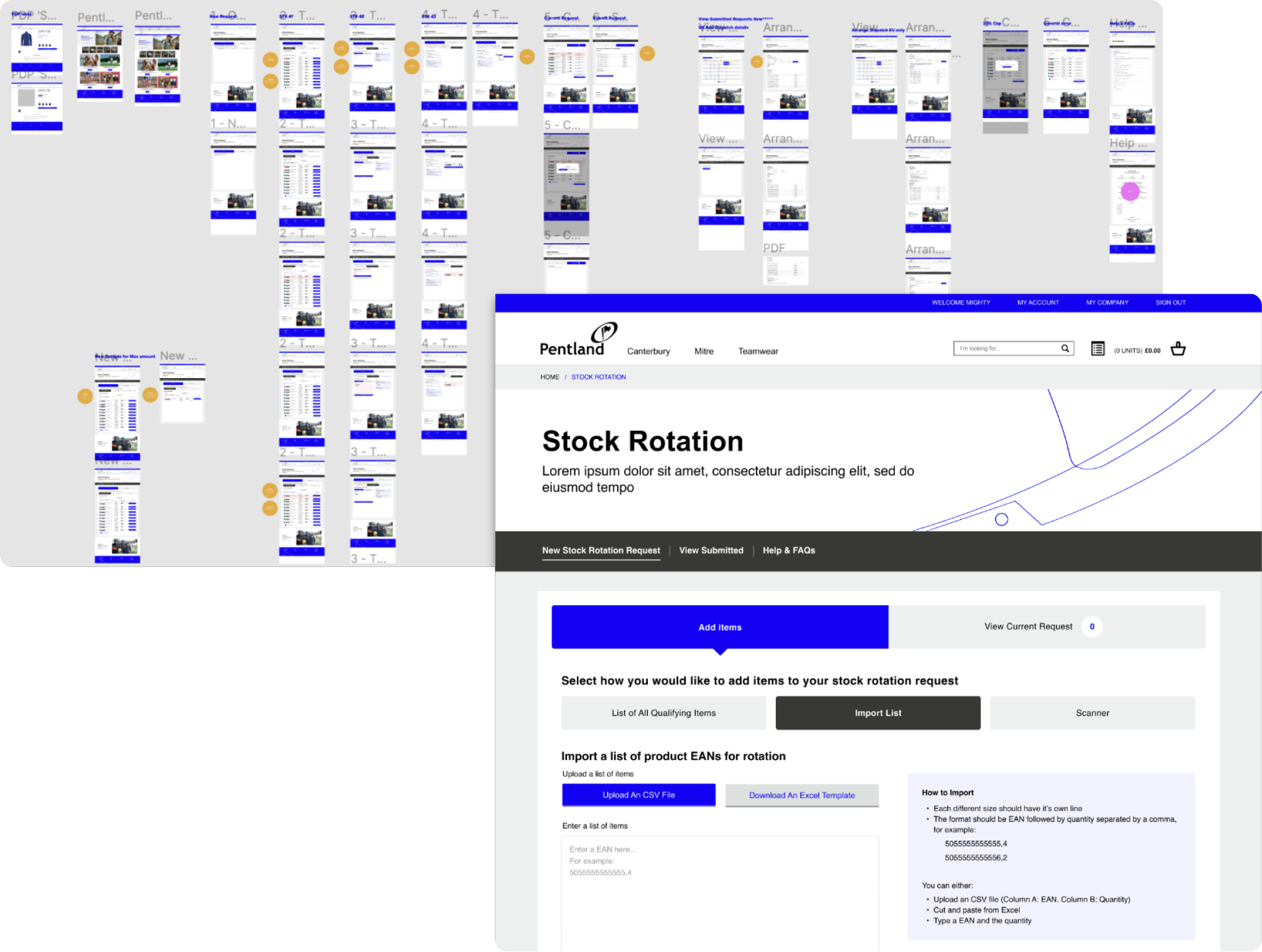
A view of the working Figma design file covering all the possible website change states, error messages, variations etc. The working prototype is available to view through the button above.
These screens, along with the prototype were used predominantly by the Engineers and BAs as they built the portal. The detail shown through the many screen variations covered all the user stories that the portal had to cater for as a Customer moved through their online journey.
A selection of screengrabs from my designs. These were created using the existing Pentland design system, and I iterated the designs based on technical constraints and feedback from Engineering. My eventual handoff to the Engineers was done using Figma Dev Mode.
Next Case Study